Beyond the Glass, There Is a Person
At Bar Ночь, Owner-Bartender Mayoi Tama Creates a Place Where Every Guest Can Find Their Own Kind of Night
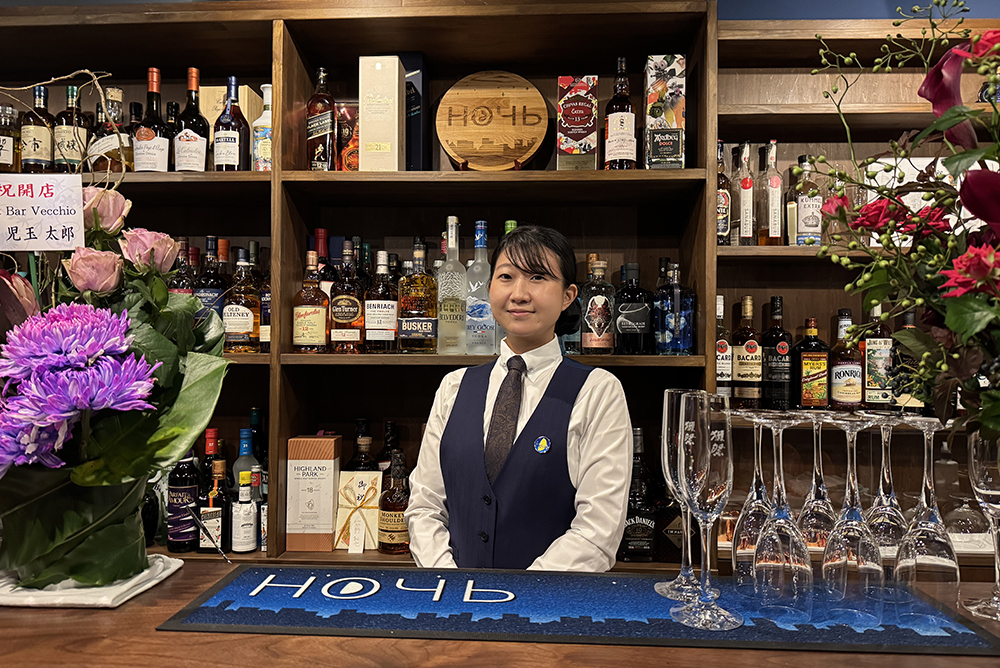
Behind a beautifully grained wooden counter, bottles from around the world line the shelves in quiet order. Standing among them is Mayoi Tama, the owner-bartender of Ночь, a newly opened bar shaped by years of experience, unexpected encounters, and a deeply personal philosophy of hospitality.
In May 2025, Tama won the Grand Prix at the 10th Nadeshiko Cup, a bartending competition held as part of the Tokyo International BarShow. Approximately one year later, she opened a bar of her own. “More than anything, I am genuinely happy that the bar I had envisioned has finally taken shape,” she says. Her expression conveys not only the joy of seeing a long-held dream become reality, but also the quiet determination of someone who has chosen to take responsibility for every detail of the place she has created.
If I Was Going to Take the Leap, It Had to Be Now
After leaving the bar where she had worked for many years, Tama spent several months at another establishment in Asakusa. There, she encountered approaches to bartending and working life that differed from those she had previously known. “I realized how many worlds there were that I still knew nothing about,” she recalls. “It was tremendously stimulating, and it also gave me an opportunity to reassess myself.”
The experience awakened in her a desire to create a place where she could express, in her own way, everything she had learned and cultivated throughout her career. She also began thinking seriously about how she wanted to work in the years ahead. “I wanted to create a way of working that I could sustain for a long time, while taking my own physical strength and lifestyle into consideration,” she says. “I decided that if I was going to take on this challenge, now was the time.”
Opening her own bar was not the final step in a meticulously planned career path. Rather, it emerged gradually from a convergence of circumstances: encounters with people, the discovery of the right property and the encouragement of those around her. Each of these elements gently pushed her towards independence.
Overcoming the Barriers of Becoming a Female Owner
The road to opening a bar was far from straightforward. Finding a suitable property was particularly challenging. In addition to the difficulties faced by many independent business owners, Tama occasionally sensed a degree of hesitation towards the idea of a woman operating a bar.
“I understand that property owners want to avoid trouble and protect their buildings over the long term,” she says. “Within that context, I struggled with how best to communicate my commitment and my vision.” International instability and shortages of materials created further complications, affecting both the procurement of supplies and the construction process.
That the bar was ultimately completed was due in no small part to the support of the interior contractors and many others involved in the project. As Tama looks back on the period leading up to the opening, one word repeatedly enters the conversation: gratitude. She does not regard the bar as something she built through her own efforts alone. The recognition that many people helped bring it into being lies at the heart of her approach to her work.
The Grand Prix Was Not the Finish Line
Winning the Grand Prix at the 10th Nadeshiko Cup significantly broadened Tama’s professional world. Following her victory, she received more invitations to participate in events and projects related to alcoholic beverages. She also began meeting people from areas of the industry with which she had previously had little contact.
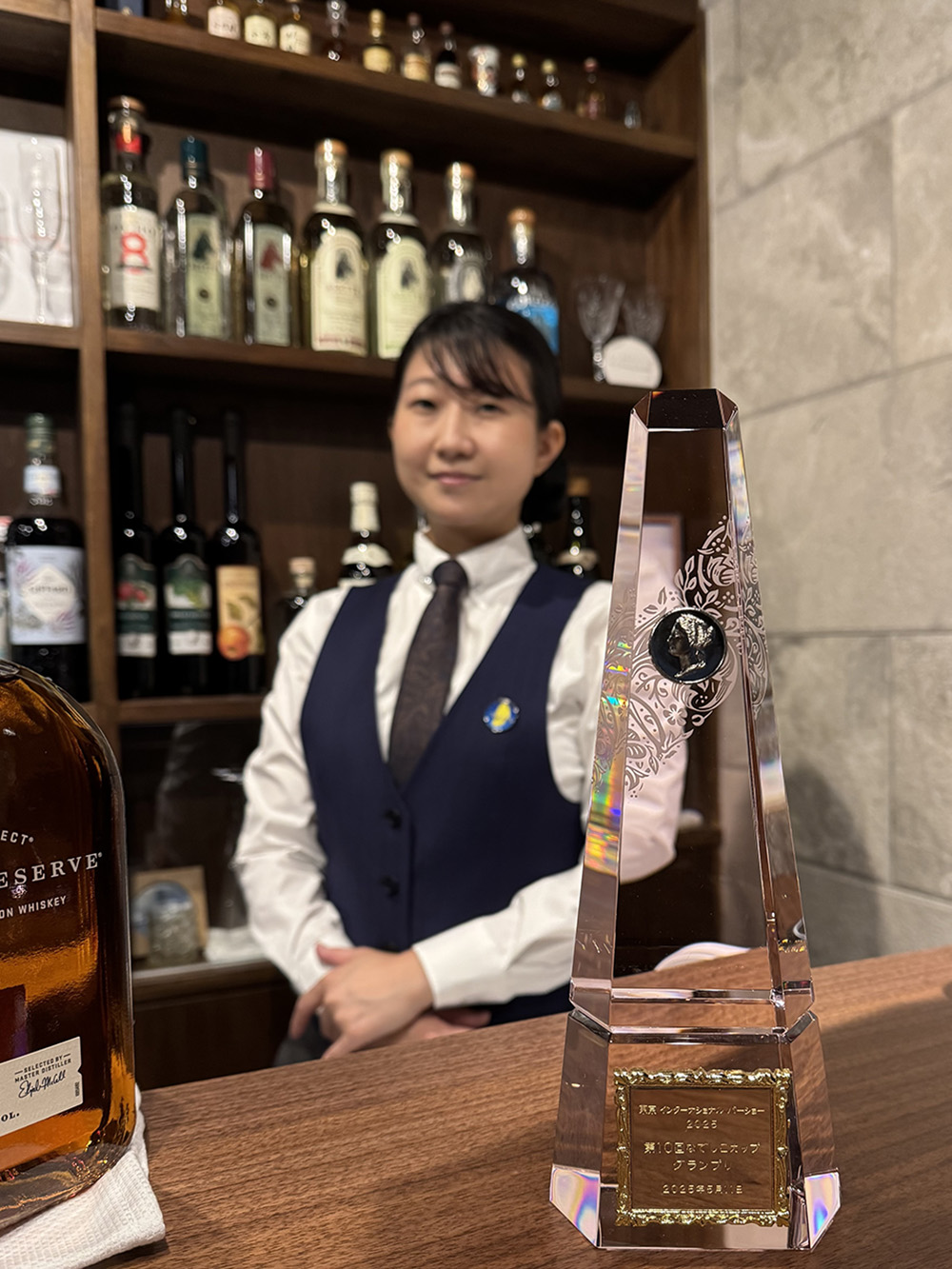
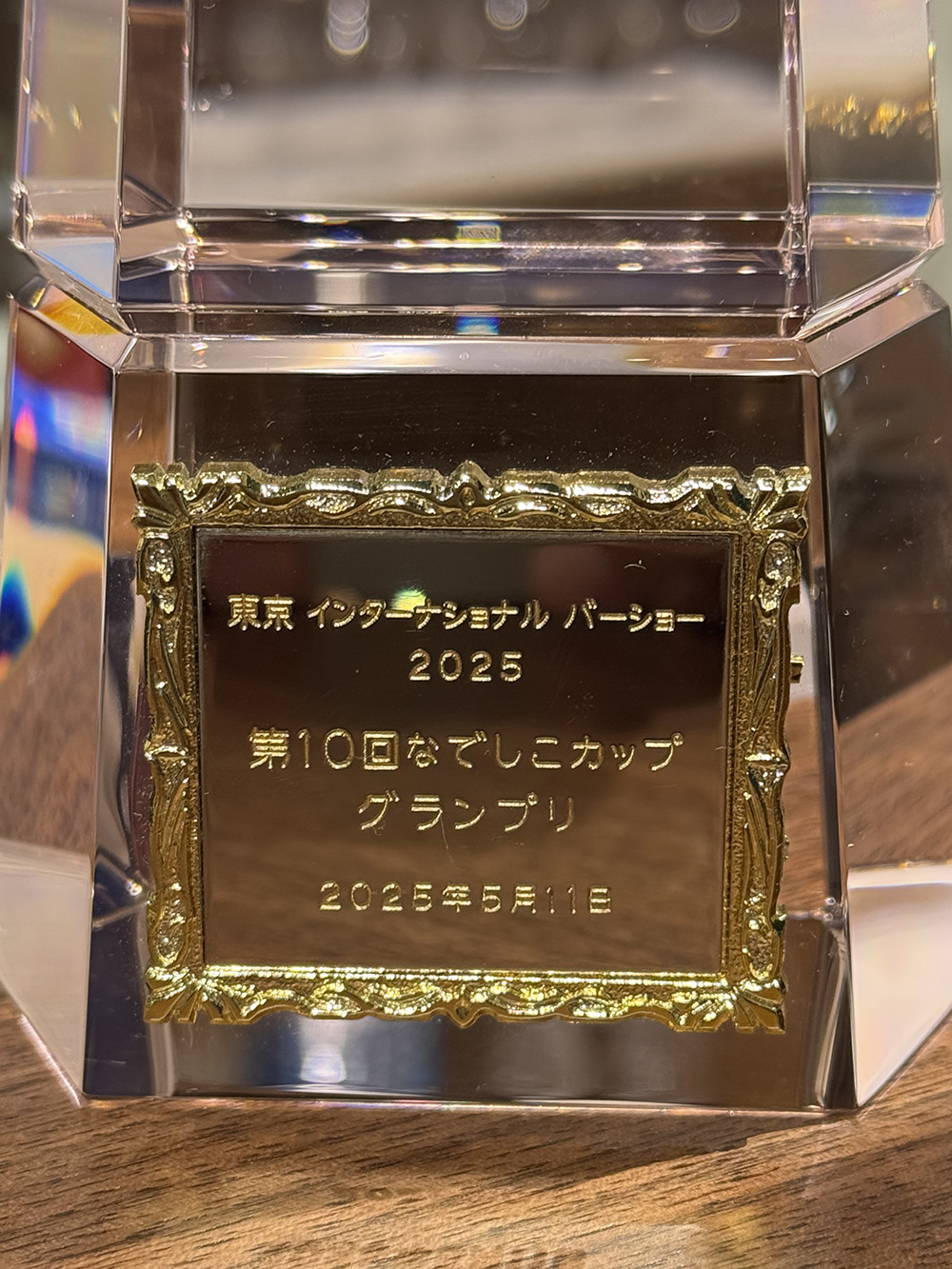
“Before the competition, I often worked within a relatively limited environment,” she says. “Winning opened up my world all at once. Being exposed to new values and ways of thinking has become an invaluable asset.” Yet one thing remained unchanged: the warmth of those who supported her. Some had encouraged her long before the competition, while others entered her life after her victory. Together, their support gave her the confidence to undertake the much larger challenge of opening her own establishment.
Asked what she would say to the version of herself who had just won the Grand Prix, Tama pauses before answering. “I would tell her that the moment of victory is not the goal. It is the beginning of something new. Encounters and experiences that she cannot yet imagine are waiting ahead. Even when she feels uncertain, I would tell her to continue straight along the path she believes in.”
What Makes a Good Bartender?
For Tama, the essence of bartending lies not only in technical brilliance. “What I value above all is hospitality,” she says. Every guest seeks something different from a bar. Some wish to spend time alone in silence. Others hope to converse with the bartender or with the person seated beside them. Some arrive after work, looking for a place to reset their thoughts. Others come for a final drink at the end of a special day.
“I believe a good bartender must be able to find the right distance and the right way of communicating with each individual guest,” Tama explains. “I want to understand the kind of time and space that person is looking for and offer hospitality that responds to it.” She has often heard female guests say that the presence of a woman behind the counter makes entering the bar feel less intimidating. For those unfamiliar with bar culture, even opening the door can require a little courage. Helping such guests take that first step with confidence is one of the great pleasures of Tama’s work.
Capturing the Atmosphere of the Night in a Single Glass
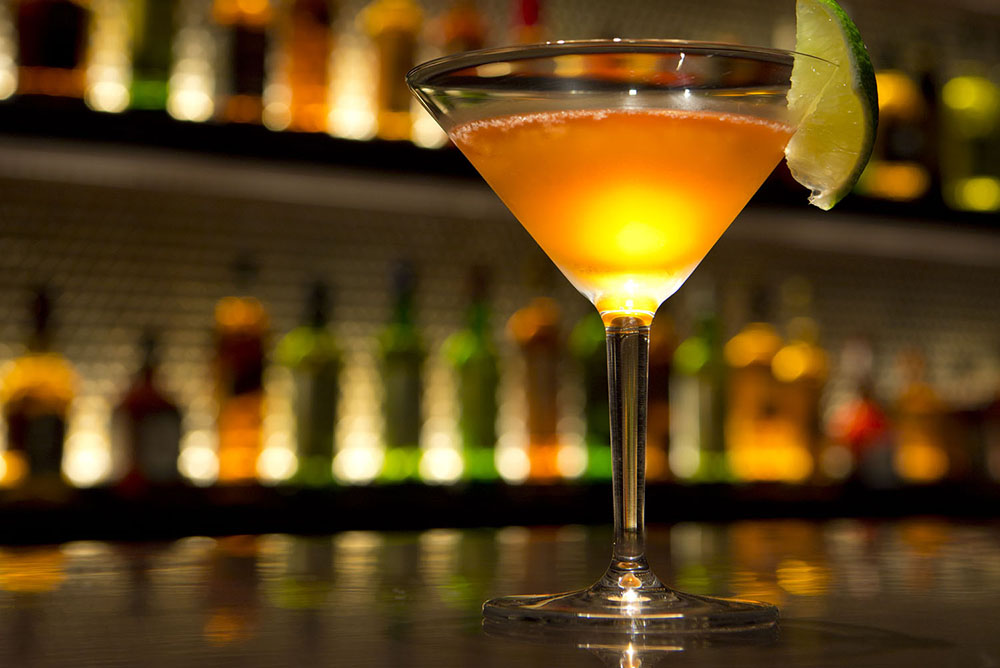
To Tama, a cocktail is not simply the result of combining ingredients according to a recipe. “I put my own interpretation and feelings into every drink I make,” she says. The history of the spirit, the character of its ingredients, the conversation with the guest, the mood of the evening and the atmosphere inside the bar all become part of the finished glass. Naturally, the drink must be delicious. But taste alone is not what Tama hopes her guests will take home with them.
“I want them to leave with the feeling that the time they spent here was meaningful,” she says. “I hope that a cocktail can make a particular moment of their day remain in their memory as something slightly more special. Nothing would make me happier.” Beyond every glass is someone’s night. Tama’s role as a bartender is to support that night, quietly and attentively.
A Different Kind of Night for Every Guest
The name Ночь, pronounced Noch, means “night” in Russian. Because the English word night is already widely used in the names of bars and other establishments, Tama wanted to find a word with a more distinctive resonance. Having studied Russian in the past, she was drawn to the quiet, nostalgic sound of Ночь. “I like the way saying ‘I’m going to Ночь’ can also feel like saying, ‘I’m going into the night’ or ‘I’m stepping into the world of night,’” she explains.
Ночь is not intended to be merely a place where people consume alcohol. It welcomes the person who wants to sit quietly alone just as readily as it welcomes those who wish to talk late into the evening. Tama hopes it will become a place where every visitor can experience the night in their own way.

The Warmth of Wood and the Sound of Classical Music
The interior reflects Tama’s vision in every detail. A wooden counter and tables bring natural warmth to the room, while red-toned sofas introduce a sense of comfort and intimacy. Tama held repeated discussions with the interior contractors, carefully considering everything from the flooring and the solid-wood counter to the furniture, lighting, and overall color palette.
The music is primarily classical, with works by composers such as Tchaikovsky and Rachmaninoff. It is never intended to dominate the room. Instead, it flows gently behind the drinks and conversations, helping create an atmosphere in which guests can release the tension of the day and spend the evening at an unhurried pace.
The drinks selection is centered on whiskies that are approachable even for those who are not regular bar-goers. At the same time, the shelves offer a broad range of craft gins and vodkas, ensuring that more experienced drinkers may also encounter something unfamiliar. For first-time guests, Tama offers simple advice. “Begin by ordering whatever you feel like drinking,” she says. “And when you are uncertain, please feel free to speak with me. I can ask about your mood and preferences and suggest something suitable.”
Discovering Another Side of the City Through a Japanese Bar
To welcome international visitors, Ночь offers menus in both Japanese and English. Tama says overseas guests sometimes ask whether it is common in Japan for customers and bartenders to engage in such extensive conversation. The appeal of a Japanese bar lies not only in the delicacy of its cocktails or the precision of its techniques. It is found equally in the attention paid to the ice and glassware, the grace of the bartender’s movements, the conversation across the counter and the subtle sense of distance maintained between bartender and guest.
Together, these elements create not merely a drink, but an entire passage of time. “When you want to learn about the local food or discover places worth visiting, I would encourage you to have a drink at a neighborhood bar and ask the bartender,” Tama says. “You may discover information that does not appear in guidebooks or encounter something completely unexpected.” A bar can serve as an entrance through which a traveler begins to understand the surrounding city. This, too, is one of the distinctive charms of Japanese bar culture.
The Last Line of Defense for Our Humanity
At the end of the conversation, Tama is asked what a bar ultimately means to her. Her answer is unforgettable. “To me, a bar is like the last line of defense that allows human beings to remain human.” A bar is not simply a place to drink. It is a place where a bartender and a guest meet through the presence of a single glass and face one another as human beings.
In an age increasingly shaped by convenience and efficiency, the act of sitting across from someone, exchanging words and sharing the same moment has taken on renewed significance. Five or ten years from now, Tama does not envision Ночь as a destination reserved only for celebrations or special occasions. She hopes it will become a true home bar: the kind of place people visit naturally when the thought occurs to them, “Let’s go there tonight.”
Whether entering for the first time or returning after many years, she wants every guest to leave feeling that coming to Ночь was the right choice. A new night has been lit at Bar Ночь. Under Mayoi Tama’s care, it will gradually grow into a place where many different nights—and many different memories—can begin.